
It's been quiet around here. Very quiet.

Tuesday, July 09, 2013

Tuesday, February 02, 2010
Surveying the size of your industry... and your wallet
POPAI has posted a couple of quick surveys to study the size of the marketing at-retail industry (which includes many flavors of digital signage), and to figure out how much we all get paid (probably way too little).
They'll of course be releasing the results of this information to members later this year, so I highly recommend you take a few brief minutes to fill one or both out, depending on how much you wish to share. Here are the links:
POPAI Compensation Survey: http://www.surveymonkey.com/s/Q9P5R5X
POPAI Size of the Industry Survey: http://www.surveymonkey.com/s/Q56FXRW

They'll of course be releasing the results of this information to members later this year, so I highly recommend you take a few brief minutes to fill one or both out, depending on how much you wish to share. Here are the links:
POPAI Compensation Survey: http://www.surveymonkey.com/s/Q9P5R5X
POPAI Size of the Industry Survey: http://www.surveymonkey.com/s/Q56FXRW
Friday, January 29, 2010
Running on MicroTiles on Digital Signage EasyStart
As Andrew Neale posted on DailyDOOH yesterday, they decided to try and use our entry-level Digital Signage EasyStart system to power a Christie Digital MicroTiles 1×5 column that will be in the DailyDOOH Blogger Lounge at ISE2010 in Amsterdam next week. Since nobody on my team had yet seen or worked with MicroTiles, we were rather curious to see how easy (or hard) integration would be. And having worked with all sorts of weird display formats, video distribution systems, and matrix splitters for video walls, I was a little bit worried about hooking such a display up to a product who's driving design mantra is to hide all of the low-level tech stuff from the end user.
Still, Andrew and his team are experts, and perhaps more importantly, apparently Christie's MicroTiles just work. Configuration was literally as easy as plugging a DVI cable into the controller powering the stack of MicroTiles, clicking the "detect monitor and video card" button in EasyStart, and then picking the right resolution, which in this case was an improbable 720x2700.
While I don't normally bother expounding on every new whiz-bang technology that crosses my path (and as Andrew pointed out in his post), I am greatly impressed when you can just take something out of its box, plug it in, turn it on, and have it do what you expect. And that's precisely what happened with Christie's brand-new, high-end and (currently) low-volume offering, which is particularly remarkable since that combination of adjectives is like the unholy trifecta of excuses for why so much stuff in our industry (and the AV industry in general) doesn't just work when you plug it in and turn it on.
So, my hat goes off to Christie Digital.
If you are at ISE2010, a tower of MicroTiles powered by EasyStart will be on display at booth 10N118, so you can check it out for yourselves. Unfortunately I won't be there this time around, but I'm sure Andrew, Adrian and their cohorts will take good care of you :)

Still, Andrew and his team are experts, and perhaps more importantly, apparently Christie's MicroTiles just work. Configuration was literally as easy as plugging a DVI cable into the controller powering the stack of MicroTiles, clicking the "detect monitor and video card" button in EasyStart, and then picking the right resolution, which in this case was an improbable 720x2700.
While I don't normally bother expounding on every new whiz-bang technology that crosses my path (and as Andrew pointed out in his post), I am greatly impressed when you can just take something out of its box, plug it in, turn it on, and have it do what you expect. And that's precisely what happened with Christie's brand-new, high-end and (currently) low-volume offering, which is particularly remarkable since that combination of adjectives is like the unholy trifecta of excuses for why so much stuff in our industry (and the AV industry in general) doesn't just work when you plug it in and turn it on.
So, my hat goes off to Christie Digital.
If you are at ISE2010, a tower of MicroTiles powered by EasyStart will be on display at booth 10N118, so you can check it out for yourselves. Unfortunately I won't be there this time around, but I'm sure Andrew, Adrian and their cohorts will take good care of you :)
Monday, January 25, 2010
pre-DSE mixer/party/free beer event details announced
Per last Friday's pre-announcement (which I got yelled at by Dave Haynes for), the Preset Group is now taking all comers for their digital signage mixer, which is scheduled for Tuesday, February 23rd from 6-8 at Lavo (a restaurant in the Palazzo/Venetian complex).
There's room for about 150, but there are only about 50 slots left as of the time of this writing. So if you want to go, I suggest you RSVP now.
Sponsors will be picking up the tab for the first round of drinks covered and some some food. Many of the digital signage cognoscenti (which I think is an oxymoron) will be in attendance. I'm not sure whether that's a good thing or not, but I'll check it out first-hand before passing judgment :)
If you're interested, you can sign up here: http://dslvmixer2010.eventbrite.com/

There's room for about 150, but there are only about 50 slots left as of the time of this writing. So if you want to go, I suggest you RSVP now.
Sponsors will be picking up the tab for the first round of drinks covered and some some food. Many of the digital signage cognoscenti (which I think is an oxymoron) will be in attendance. I'm not sure whether that's a good thing or not, but I'll check it out first-hand before passing judgment :)
If you're interested, you can sign up here: http://dslvmixer2010.eventbrite.com/
Free digital signage content to help Haiti
I'm stealing this directly off of Dave Haynes's blog for a number of reasons, not the least of which is that it's a good cause:

A series of very simple hi-rez video spots are available now for download that help continue to drive awareness and donation for the relief effort in Haiti. Network operators can use to help direct funds to Red Cross groups in the US and internationally.
The downloads are available here: http://www.presetgroup.com/downloads/index.html
Landscape and portrait versions are available, and there are a few different file formats. We also left the Final Cut Pro file up there for producers to download. (That alone saves them 2 - 3 hours of work).
ANYONE can have these, including other networks, any end-users. You can even download the Flash versions and resize for your website, if you so choose.
Wednesday, January 20, 2010
Raise 'da roof with a bunch of digital signage geeks in Vegas next month
The Preset Group is having a free digital signage industry mixer on Tuesday, February 23rd at Lavo, a restaurant in the Palazzo/Venetian hotel between 6 and 8 p.m. They expect a good turnout, and have promised to provide a vendor-neutral, hype-free zone (as much as that's possible in our industry, anyway).
The sign-up sheet goes live on Monday, so check back here to find out how to sign yourself up.
See you there!

The sign-up sheet goes live on Monday, so check back here to find out how to sign yourself up.
See you there!
Thursday, January 14, 2010
Bloggers of the world, unite!... in comfort
Adrian Cotterill of DailyDOOH fame sent this over to me this morning, and I'm posting it because:
a) as a blogger, I hope he does the same at DSE so that I might not have to pay $7 for crappy Starbucks coffee outside the expo hall, and
b) he said that if I wasn't nice to him, he wouldn't vote for me for digital signage man of the year
So, without further ado, here's the good news for digital signage bloggers who will find themselves in Amsterdam next month:

a) as a blogger, I hope he does the same at DSE so that I might not have to pay $7 for crappy Starbucks coffee outside the expo hall, and
b) he said that if I wasn't nice to him, he wouldn't vote for me for digital signage man of the year
So, without further ado, here's the good news for digital signage bloggers who will find themselves in Amsterdam next month:
Comfy Couches and Espresso Machines Lined Up for Blogger Lounge at ISE
2010 AV Trade Show

DailyDOOH news portal and blog for digital signage sector arranges
industry-first new-style press room for bloggers on hall floor of
major European technology show

LONDON - Bloggers have re-written the rules on how industries are
watched and analyzed, and now a leading technology and media blog is
changing the way trade shows are covered by these new-style
journalists.

Bloggers at next month's Integrated Systems Europe show in Amsterdam
will have comfy couches and chairs, free high-speed Internet and a guy
on hand making them all the espressos and lattes visitors can sip.

The Blogger Lounge, organized by digital signage/digital out of home
business DailyDOOH, is thought to be the first of its kind for such a
large AV show. While press rooms for mainstream and trade press are
typically hidden away far from a trade show's action, the DailyDOOH
Blogger Lounge will be located right among the booths and attendees in
the trade hall.

"We wanted to put together an area that was comfortable and relaxing,
and would allow our own writers and our friends who cover the industry
to sit, write, meet and catch their breath," explained Adrian
Cotterill, UK-based DailyDOOH's Editor in Chief. "This is going to be
the place where a lot of the buzz around ISE will be created and
relayed to readers all over the globe."

Cotterill added his hopes that the lounge attracts not only the
digital signage crowd, but writers more focused on the AV and systems
integration sector.

"People tend to not always realize the influence that bloggers and
social media in general has on how companies, and the industry as a
whole, are viewed," noted Dirk Huelsermann, the president of OVAB
Europe, whose booth will be next to the Blogger Lounge. "We're going
to see blogging and social media right in the middle of the event, and
that's fantastic."

The International Systems Integration show runs Feb. 2-4 at Amsterdam's RAI.

The DailyDOOH Blogger Lounge will be located in hall 10 at stand 10N118
Saturday, January 02, 2010
One bad apple spoils the whole...
pie? cake? tart? I don't know how that expression ends.
Regardless, Happy New Year!
No, this blog isn't dead. I just had a much busier than anticipated end-of-year, and frankly there wasn't that much digital signage news worth talking about (and plenty of other folks do a good job of covering the news anyway).
This is just a quick update to note that a) yes, I'll continue posting in 2010, and b) I'm enabling comment moderation on posts older than 2 weeks, because some asshat has been spam-commenting on this blog for the past couple of days in what appears to be a , very amateurish attempt at search engine optimization.
So I'm sorry if that inconveniences anyone. Obviously I'm not going to mention who the spammer is, since that would just draw attention to them, which is exactly what they want, the jerks.
Here's to a happy, healthy and prosperous new year.
-Bill
Wednesday, November 25, 2009
A Black Friday / Cyber Monday sale on digital signage!
If you live outside of the US, you might not know that this coming Friday (the day after our Thanksgiving holiday, which always falls on the fourth Thursday in November) is the so-called Black Friday, when retailers pull out all the stops to get you started on your holiday shopping in hopes of moving out of the red and into the black. A typical Black Friday scenario looks something like this:
The Monday after Thanksgiving Day has now been relabeled "Cyber Monday", as it's the day when everybody (ostensibly) goes back to work after the long holiday weekend, and proceeds to spend the entire day online shopping for deals. It's the more laid back, refined way to shop like a crazy person, even if its name lacks the pirate-esque panache of "Black Friday."
Back here at HQ we were thinking about how we wanted to approach this holiday season -- normally a less-busy time than the August-November period preceeding it, and decided that consumer products companies shouldn't have all the fun. So we decided to do a Black Friday/ Cyber Monday deal of our own for our Digital Signage EasyStart product. There's precious little data out there on whether such short-term promotions work on B2B products (honestly, how many B2B "impulse purchases" have you made in the past 5 years?), but we figured it's worth trying out. Here's our ad:

Technorati Tags: digital signage, digitalsignage

- Drag yourself away from the table after stuffing yourself with far too much turkey, cranberry sauce, cake pie, and other holiday goodness.
- Get in the car at around 10:30 PM.
- Drive to the Walmart/Best Buy/Target/Macy's or other store that you have picked as your primary Black Friday target after carefully weighing its location versus the population of the surrounding area, and the outside temperature.
- Wait in line until about midnight.
- Push you way through hoards of other shoppers to get one of the 5 $199 plasma TVs or $50 Egyptian cotton sheet sets (or whatever else) that the store has been advertising for 3 weeks, but hasn't bothered to stock any more of.
- Leave with a sense of ultimate victory (if you're one of the lucky few), or, more likely, a bitter taste in your mouth and a bunch of bruises from where you got crushed by the aforementioned hoards.
The Monday after Thanksgiving Day has now been relabeled "Cyber Monday", as it's the day when everybody (ostensibly) goes back to work after the long holiday weekend, and proceeds to spend the entire day online shopping for deals. It's the more laid back, refined way to shop like a crazy person, even if its name lacks the pirate-esque panache of "Black Friday."
Back here at HQ we were thinking about how we wanted to approach this holiday season -- normally a less-busy time than the August-November period preceeding it, and decided that consumer products companies shouldn't have all the fun. So we decided to do a Black Friday/ Cyber Monday deal of our own for our Digital Signage EasyStart product. There's precious little data out there on whether such short-term promotions work on B2B products (honestly, how many B2B "impulse purchases" have you made in the past 5 years?), but we figured it's worth trying out. Here's our ad:
While I'm not normally a fan of discounting, I have to admit that if I were a business buyer, I'd be pretty psyched about getting a deal by just playing along with some silly American tradition.
In any event, if you or anyone you know does happen to be looking for a digital signage player or interactive kiosk for small networks, just click on the ad above, file an info request, and finalize your purchase by next Friday, and you automatically qualify for the deal.
If not, it's OK, I still like you. Just not as much as before.
So happy Thanksgiving to those of you in the US. And to everyone else, happy rest-of-the-week!
In any event, if you or anyone you know does happen to be looking for a digital signage player or interactive kiosk for small networks, just click on the ad above, file an info request, and finalize your purchase by next Friday, and you automatically qualify for the deal.
If not, it's OK, I still like you. Just not as much as before.
So happy Thanksgiving to those of you in the US. And to everyone else, happy rest-of-the-week!
Thursday, November 19, 2009
PlayByPee encourages radio listening
I'm having trouble deciding whether this is brilliant or insane, but it's definitely unique. AdAge reported a few days ago about a decidedly #1 way to promote sports radio:

Canadian sports radio station AM640 wanted to promote its live commentary of ice hockey games. To show fans how exciting audio can be, it installed a poster over a urinal that provides commentary of the person doing their business.The radio station targeted a toilet it knew would be full of ice hockey fans -- the one at Air Canada Bowl. When a fan approached, an excitable commentary lifted from an ice hockey game -- but one equally applicable to taking a pee -- began to play. Lines such as "He's approaching the bowl" played in an audio clip culminating with an ecstatic cry of satisfaction from the commentator.
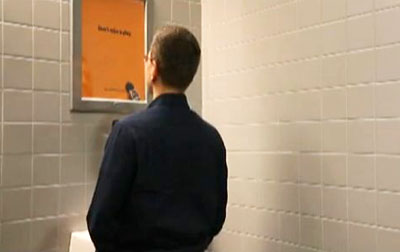
This isn't the first time that people have tried to bring some kind of digital advertising to the urinal. In fact, I've have a couple of clients who have been putting up digital screens in men's rooms for quite some time. Heck, we've even seen interactive games where men are instructed to pee in certain places/directions to "drive" a car on a screen. (Ostensibly this was done to test whether the player was too drunk to drive home from the pub, but c'mon, we all know the truth).
Personally, I'm not too sure how I'd react to a play-by-play of stepping up to the urinal.
Thursday, November 05, 2009
Wireless Ronin (RNIN), running out of money, asks public for more
After reviewing Wireless Ronin's quarterly statement yesterday, I noticed that they're down to a bit less than a year's worth of cash -- at least their current, totally ridiculous burn rate of something like $700K/month.
Consequently, I was not at all surprised to see this announcement pop up that they're now seeking an additional $6.7M by selling new shares at $2.90/apiece to an anonymous investor.
What I want to know is, honestly, who's going to invest in them at this point? Their model is broken, as is evidenced by the fact that they're getting further and further into the "consulting" by doing software development and content production projects. And believe me, there's nothing wrong with that at all. But that's a very different business than the digital signage game, one that's very hard to scale, and (amazingly) one that's even more crowded with competitors than the digital signage software space.
Still, I'm jaded to the point where I expect this round of funding will close, the firm will get a stay of execution, and will once again not have to make the difficult decisions, like:
1. Really slashing their headcount. RNIN ought to be able to get by (on those revenues, at least) with a headcount of 15-20 people, not 4-5x that number. It's not fashionable to talk about layoffs these days, I know. But as a publicly-traded entity RNIN is accountable to their shareholders first. Which is why they probably out to think about...
2. Going private. Yup, it's also not fashionable, but at this point I have to imagine that RNIN's ticker symbol is hurting more than helping when they go to pitch big deals. Admittedly, being public (and apparently having a totally genius financial adviser) gives them the ability to back for money over, and over, and over, and... well, you get the picture.
3. Giving their cash to me. There, I said it. I'm certain I could put it to good use :)

Consequently, I was not at all surprised to see this announcement pop up that they're now seeking an additional $6.7M by selling new shares at $2.90/apiece to an anonymous investor.
What I want to know is, honestly, who's going to invest in them at this point? Their model is broken, as is evidenced by the fact that they're getting further and further into the "consulting" by doing software development and content production projects. And believe me, there's nothing wrong with that at all. But that's a very different business than the digital signage game, one that's very hard to scale, and (amazingly) one that's even more crowded with competitors than the digital signage software space.
Still, I'm jaded to the point where I expect this round of funding will close, the firm will get a stay of execution, and will once again not have to make the difficult decisions, like:
1. Really slashing their headcount. RNIN ought to be able to get by (on those revenues, at least) with a headcount of 15-20 people, not 4-5x that number. It's not fashionable to talk about layoffs these days, I know. But as a publicly-traded entity RNIN is accountable to their shareholders first. Which is why they probably out to think about...
2. Going private. Yup, it's also not fashionable, but at this point I have to imagine that RNIN's ticker symbol is hurting more than helping when they go to pitch big deals. Admittedly, being public (and apparently having a totally genius financial adviser) gives them the ability to back for money over, and over, and over, and... well, you get the picture.
3. Giving their cash to me. There, I said it. I'm certain I could put it to good use :)
Tuesday, October 27, 2009
When digital signs leave a bad taste in your mouth... or something
Ran into two articles that seem to fit well together.
 The first comes from The Consumerist, where reader Grey was confronted (and affronted) by a shelf-edge signage system for Bumblebee Tuna:
 The inanity of the Bumblebee display must have primed my brain because when I ran into this article at Advertising Lab it seemed like it might as well have come from the same company. Straight out of the what-were-they-thinking department of RightGuard's R&D lab comes this inspired idea to put digital advertising not where one might purchase the product, but where one might actually use the product. That's right, we're talking about armpit advertising! Awful puns aside (and there are lots of them), there's really not much else I can say about this. In fact, I think the expression of the woman on the left pretty much says it all...

The first comes from The Consumerist, where reader Grey was confronted (and affronted) by a shelf-edge signage system for Bumblebee Tuna:This absurd Bumblebee Tuna display was jutting into the isle at my local Safeway. It had a black screen, single silver button, and a card stock sign demanding I "push the button." Out of nothing more than utter disbelief and morbid curiosity I bow to the will of the sign.The guy sounds a little whiny, and is obviously saddled with a either a serious TV addiction or else a terribe lack of willpower if the mere presence of the diminunitive screen was enough to "force" him to push the button or see what happens. That aside though, the remainder of his complaint is completely valid. 30-second TV spots have no place at the shelf-edge, especially if/when they rely on audio and will be presented on a postage stamp-sized display. Kudos to Bumblebee and SmartSource for taking a stab at low-power and presumably low-cost digital shelf-edge advertising, but guys, seriously, you need to do a lot better. At least bundle some coupons with the thing. If you want a laugh, I recommend you read the comment thread attached to that article at The Consumerist.
"Will it start talking to me, the grocery store shopper?" I wonder. "Perhaps it will suggest some Tuna-themed dish for me to prepare for dinner tonight?" No. Instead I see the lowest resolution version of some 30 second, made for TV ad I'd ever seen.
The inanity of the Bumblebee display must have primed my brain because when I ran into this article at Advertising Lab it seemed like it might as well have come from the same company. Straight out of the what-were-they-thinking department of RightGuard's R&D lab comes this inspired idea to put digital advertising not where one might purchase the product, but where one might actually use the product. That's right, we're talking about armpit advertising! Awful puns aside (and there are lots of them), there's really not much else I can say about this. In fact, I think the expression of the woman on the left pretty much says it all...Monday, October 26, 2009
Putting signs between you and your fix
First Dave Haynes notes the creation of a new smoothie vending machine with digital screens attached and now this (from Engadget):
http://www.youtube.com/watch?v=ZY1uDPO_3ps&feature=player_embedded

While it's still a concept, [Douwe Egberts]'s so-called BeMoved coffee machine promises to finally bring the disparate worlds of hot beverages and motion control together at last, and do nothing short of raise "human interaction with a coffee machine to a higher level" in the process. Because, really, you can never truly feel close to a coffee machine until it's taunted you to jump up and down to fill your cup of joe. Of course, you can also do some slightly more practical things like tailor your coffee exactly the way you like using the massive touchscreen, and even check up on the weather and news while you wait.
http://www.youtube.com/watch?v=ZY1uDPO_3ps&feature=player_embedded
Wednesday, October 21, 2009
Online Ads Not Working for You? Blame the Creative
Digital: Online Ads Not Working for You? Blame the Creative - Advertising Age - Digital
Something we've harped on for a long time over at WireSpring is the need for great content on your digital signage systems. Too often, people blame their network failures (and there have been many of these over the years) on cost management, technology problems, unwilling advertisers and dozens of other things, when in reality the real problem was that their content wasn't compelling, and consequently their network wasn't achieving its goals.
We're not alone in this problem, as the above-linked AdAge article explains:
It's bad creative that makes online advertising ineffective, so stop obsessing over targeting and placements, according to a study from online-ad-research group Dynamic Logic.After analyzing the highest and lowest performers from its database of more than 170,000 online ads, the Millward Brown company determined that creative factors such as persistent branding, strong calls to action and even human faces -- and not super-targeted or high-profile ad placements -- make for better ad recall, brand awareness and purchase intent.
Simply put, an ad is only as strong as its weakest links, and according to the Dynamic Logic study, that weakest link is frequently the quality of the creative itself. Not planning, not placement, not measurement, but content.
Digital signage content producers and ad network owners need to keep this in mind when deciding how to apportion their budgets. Don't leave enough in for good creative, and you might be deploying a very expensive, very failure-prone network.
In-Store Marketing Beats Traditional Ads
In-Store Marketing Beats Traditional Ads, according to a new survey conducted by the National Research Network on shopper marketing firm Miller Zell’s behalf. The study notes:
Nearly a third (32 percent) of the 999 shoppers polled online in March said that in-store marketing is "very effective." Only 27 percent said the same about ads living outside of the store.I don't really have any commentary to add here -- the results more or less speak for themselves, and in my mind make a lot of sense. We continue to see data posted indicating that in-store marketing is a must-have component of any CPG marketing mix, and certainly big guys like P&G have been pouring resources into making their in-store presence more effective. While one might treat data compiled on behalf of a company that stands to profit for them as suspect, I think in this instance we're seeing further corroboration of past studies and common sense understanding of how marketing at retail works.
The report, which is part three of the “Gone in 2.3 Seconds: Capturing Shoppers with Effective In-Store Triggers Series,” found that the shopping experience is crucial for marketers. Sixty-nine percent of those polled called the in-store experience a “make or break” scenario. While 65 percent of shoppers are making lists, brand decisions are still being made at the store, according to 60 percent of respondents.
End-aisle displays are the most engaging according to 70 percent of those polled, followed by merchandising displays (62 percent), and department signage (58 percent). Ceiling banners and overhead mobiles have the least impact.
Shelf strips (55 percent) and shelf blades (50 percent) have become more important, especially among the Gen X and Gen Y crowds, who feel the more information the better, per the report. Overall, women and Gen Y consumers were most influenced by in-store marketing efforts.
 Subscribe to this blog
 Follow Bill Gerba on Twitter