
Tuesday, April 15, 2008

The morning press - digital signage news for April 15

Here are some of today's interesting clips from the web:

  • 3M unveils digital signage center - 3M Commercial Graphics Division, a division of 3M Ltd, has launched its Digital Signage Centre of Excellence (CoE) at the 3M Innovation Centre in Bangalore. A one-stop shop for digital signage's, the Centre will display and demonstrate a wide range of innovative solutions for customers.
  • SeeSaw Networks partners with LocaModa - LocaModa enables SeeSaw affiliates to create a virtual presence on social networks for each of their venues. For example, a particular bar or coffee shop on Main Street can also exist on Facebook, where people in the venue or fans of the venue appear online. LocaModa also provides a suite of interactive applications like contests and games that networks can incorporate into their programming to attract people to participate, thus making the screens more engaging and rewarding for the consumer. While at first glance the combination of social networking with out-of-home dynamic media seems to "feel" right, I have to sit and think a while about the true potential of such a combination, and the extent to which it would likely ever by utilized.
  • WiFi and GPS Combined Move Outdoor Audience Measurement Indoors - Under an exclusive licensing arrangement, RDPA with Nielsen Outdoor, a division of The Nielsen Company, developed a proprietary GPS device - the Nielsen Personal Outdoor Device, or Npod - about the size of a cell phone that members of a randomly selected sample carry in their pockets, place in their cars, or wear like a pager. The sample member’s path and travel speed is aligned with the “visibility zone” of out-of-home advertising sites, taking into consideration each site’s precise position, size, illumination status, and direction it is facing. The resulting measurement of opportunity to see delivers reliable reach, frequency, and site-specific ratings data on real people, passing real sites, in real time.
  • DISH Network Announces Digital Signage Solutions - DISH Network has decided to extend its business solutions services to provide digital signage platforms for clients to address a variety of communications needs. DISH Digital Media Services, which includes DISH DIGITAL SIGNS and DISH EzSIGNS, combines DISH Network’s fleet of satellites, national installation network, uplink centers, and teleport fiber POPs nationwide to provide commercial and private businesses with live and stored digital communications content.
  • AirMedia Announces Installation of 1,213 Digital Frames in 16 Airports - One of the few publicly traded digital signage companies, Chinese giant AirMedia upgraded from light boxes or newly installed 889 digital frames, ranging from 46 to 50 inches, in 11 airports located in Beijing, Shenzhen, Chengdu, Hangzhou, Xi'an, Wuhan, Nanjing, Zhengzhou, Jinan, Hefei and Yantai. AirMedia also installed 324 large-size digital frames, ranging from 63 to 70 inches, in 9 airports located in Beijing, Shenzhen, Kunming, Chongqing, Changsha, Haikou, Zhengzhou, Ningbo and Hefei. AirMedia has been operating digital frames in Beijing Capital International Airport since December 2007 and will start to operate digital frames installed in other airports in April 2008.

Tags: ,

Looking for more digital signage info? Check out WireSpring's Kiosk and Digital Signage blog for in-depth industry analysis and even more news about the digital signage industry. While you're there, feel free to read up on our digital signage software and services

Monday, April 14, 2008

Sorenson finds coupons, signs beat in-store TV and audio

By now we've heard lots about the in-store measurement efforts from Nielsen (PRISM) and POPAI (MARI), and we've even seen a bit of data from both, but as AdAge tells us, TNS Sorenson has stepped up their efforts, and is providing some very interesting data on what works -- and what doesn't -- when marketing at retail.

Some of Sorenson's research echoes results from the PRISM pilot data released earlier this year. For example:
[s]ome of the more-established mainstays of category promotion, such as in-store sampling and instant-coupon machines (from News Corp.'s SmartSource) resonated well with consumers in surveys. But some applications more like traditional media advertising, including in-store TV and floor ads, fared worse.
I'm looking around for the data or an executive summary of the report to figure out just what exactly "fared worse" means, but no luck so far. Still, this shouldn't come as news since we've seen a number of reports in the recent past indicating that traditional in-store promotions continue to perform well (and have a gigantic footprint, economies of scale, and the benefit of expert practitioners). Additionally, Sorenson found the most influential media to be (in order) in-store samples, package ads, coupon dispensers, in-store fliers and end-aisle displays. The least influential were ceiling ads, in-store audio and floor ads. The stuff that we're typically intrested in -- in-store digital signs (#13), other video displays (#14) and checkout-lane ads (#15) were all towards the bottom in terms of relative effectiveness.

Sorenson indicated that, "relevance is key to any media working in-store... so the more closely aligned the ad is with the category and product, the better." Additionally, many newer in-store media (particularly digital signs) fared poorly, he feels, because of logistical challenges that often leave the screens hanging from the ceiling instead of placed in a better locale, such as the spot approximately 40" above the floor known to be where shoppers are known to focus their attention.

Clearly, execution of the promotion program is just as important as the medium the program will be running in (especially true since so many programs are mixed-media nowadays), so I'd have to recommend readers take these results with a grain of salt: marketers and retailers have a very solid understanding of how to make items sell on endcaps and in aisles. On screens near the store entrance or dangling from the ceiling, there are a lot more unknowns, and as Sorenson has stated, that means that we're starting from a disadvantage.

Tags: ,

Friday, April 11, 2008

Coming soon: electronic shelf labels

By now we've probably all seen that guy at trade shows, with a booth full of tiny screens showing itty-bitty digital images and mounted to on mocked up supermarket shelves. I think I've come across this tech at pretty much every major industry show I've gone to in the past five years. But I've yet to see a single deployment.

According to some news from BizJournals, that may change soon, thanks to a $52M cash injection by Galleon Group into electronic shelf label pioneer Altierre Corp. And given how cheap tech is getting and how expensive labor (and everything else) continues to become, it looks like the time for such a seemingly-overkill system might finally have come. The article notes:
The technology would eliminate the paper labels that are often changed weekly in grocery stores, freeing up workers and reducing paper waste, says CEO Sunit Saxena. ESL would also eliminate discrepancies between the shelf and cash-register prices and allow the flexibility to make immediate price changes, he says.

"You've got a poor store manager trying to orchestrate the changing prices of 40,000 products, and they just can't do it," Saxena says. "So how do you get the information out there? Through wireless networks."

The system consists of a digital liquid crystal display (LCD) device that sits on the shelves' rail and can be altered from a central computer in the store's office or company headquarters. The system uses secure Wi-Fi to change a price in less than two minutes. The digital displays are powered by batteries with a shelf life up to five years. The system would pay for itself in one to two years by eliminating the cost of paper tags, Saxena says.
While the touted benefit is the ability to change prices faster and more efficiently, there's obviously also the potential to provide additional information (e.g. nutrition info or promotions on food items), as well as more nefarious uses like real-time, demand-based price adjustments that could mean the $3.19 box of Cheerios you put in your cart turned into a $5.59 box by the time you checked out. Sure, nobody says they plan to do that, but you know they're all thinking it :)

No word on when we'll see pilots of Altierre's technology, but according to the company, two major grocers are already testing the stuff out.

Tags: ,

Thursday, April 10, 2008

"Pushing Daisies" gives multi-sensory storefront windows a shot

Here's something I haven't seen done before. As Dave Weinfeld notes, "Motomedia just launched a Streetlevel Digital Billboard for the television show "Pushing Daisies" in London. The Streetlevel Billboard offers touch and motion interactivity, as well as scent emission (meaning passersby get wafted the scent of fresh cut grass)."
I've encountered (and have been generally underwhelmed by) a number of digital shop window projects now, and while they still have an interesting novelty value, my current feeling is that either a) not enough people notice them because they're too timid, or b) they're impossibly annoying because they try to attract the attention of every passer-by.

Not having seen this window in person I can't say if it falls into either category, but I'm very curious to see if and/or how the addition of scent (in this case, fresh-cut grass, as the article notes) has any impact on performance. It's certainly a creative touch, so there's something to be said for that.

Tags: , ,

CNN Money looks at Lamar's digital billboard aspirations

Inc. profiled Magic Media's digital billboard prowess in last month's (March '07) issue, and this month CNN Money is taking a look at Lamar Advertising, whose 150,000 static billboard network makes them the third largest OOH company in the country behind Clear Channel and CBS Outdoor. Their take:
A few years ago, [Lamar CEO Kevin Reilly Jr.] and his colleagues had an epiphany: Unlike other forms of media, the basic business of building walls on stilts
and selling ads on them wasn't under direct threat from the Internet. If anything, technology could help billboard operators like Lamar save money. By using digital technology and broadband connections, Lamar could stitch together a network in which a single ad could be displayed at multiple locations. And as prices for next-generation screens fell, Reilly figured, any billboard could be turned into a veritable Jumbotron: like my digital picture frame, multiple images can be rotated across the screen.
Nothing too new for those of us in the industry, but what I found particularly interesting were the few bits about their expansion plans:
So far, Lamar has 720 digital "faces" in 120 markets, which is a small
fraction of the company's overall reach but more than the 200 billboards installed so far by industry giant Clear Channel. Lamar plans to invest $100 million a year or so over the next five or six years to install up to 6,000 more digital billboards.
Citing the difficulty of turning a diverse set of billboards into a unified ad messaging platform, the expense of present-day technologies and the impact of our current economic uncertainty, Reilly noted that there are still numerous hurdles to overcome before digital billboards become as commonplace as their static brethren (and he didn't even mention legal/regulatory issues, which I know come up very frequently when towns and locales try to resist the bright lights of a fancy new electronic sign). Still, Reilly indicated that digital billboards present both a net cost savings and revenue boost, making them the biggest thing in the billboard industry in a long time, so it's likely that Lamar and its rivals will continue to invest heavily in the strategy in the coming years.

Technorati Tags: ,

The morning press - digital signage news for April 10

Here are some of today's interesting clips from the web:

  • PumpTop TV expands to Houston, Dallas/Forth Worth - PumpTop TV's network consists of nearly 5,000 screens found at most major gas station brands in the Los Angeles, San Francisco, Sacramento, San Diego, Phoenix and now Dallas/Fort Worth markets. The Houston, New York, Chicago, Philadelphia, Boston, Atlanta and Florida markets are slated for later this year. I have to admit, these guys are growing faster than I originally expected. I'm still not convinced that a large network of these devices can be profitable, though.
  • Adspace Mall Network Expands to Minneapolis - Adspace Networks, Inc. has expanded into the Minneapolis market with the installation of its "Smart Screens" in the Eden Prairie Center, Northtown Mall and the Burnsville Center malls. The company is now in 39 DMAs, including the top 10, and has attracted hundreds of regional and local advertisers.
  • Piper Jaffray Removes Focus Media (FMCN) from Alpha List - The firm lowered its earnings estimates on Focus Media, reflecting uncertainty in regards to the long-term viability of the Company's wireless segment. As a result of the lowered estimates, Piper reduced its price target on Focus Media from $86 to $68. Considering they're still trading well below $40, that looks like a solid buy endorsement regardless, but what do I know of such things?
  • Indoor Direct Launches New Digital Media Network in QSRs - Indoor Direct is placing between two and four, 42-inch LCD screens in restaurant dining rooms, which show a mix of produced and original content. A third screen, called the Promotional Board Screen, is also being placed at the point of purchase and promotes the restaurant's featured menu items. Eight major quick service and casual dining restaurant chains have been outfitted with Indoor Direct screens. Five of those chains participated in Arbitron research.

Tags: ,

Looking for more digital signage info? Check out WireSpring's Kiosk and Digital Signage blog for in-depth news, reviews and industry analysis. While you're there, feel free to read up on our digital signage software and services

Friday, April 04, 2008

Dollar General adds in-store TV

According to the In-Store Marketing Institute, Dollar General is rolling out an in-store TV network as part of its, "increasingly brand-embracing growth strategy." The first 500 stores were outfitted with Dollar General TV, or
DGTV in March. The network is being installed and managed by SmartPic
Advertising in Sarasota, FL. Content will be five-minute loops of
vendor- and retailer-supplied clips running on 37-inch Panasonic plasma
screens placed throughout the stores. The article notes, entertainingly, that:
DGTV is different from other existing in-store networks because it
integrates promotional content with both in-store programs and online
activity, according to SmartPic ceo Jim Elliott. "Dollar General asked
us to help them rebrand the shopping experience," Elliott said. "We
wanted to do more than just throw up a monitor and some ads."
Yeah, I've never seen that anywhere before. I wish there was a way to indicate that I'm rolling my eyes in text. To be fair, the network is employing some clever stuff, including "a three-dimensional
treasure chest that kids are encouraged to search for within the store.
The dispenser holds tokens redeemable at checkout for vendor-supplied
prizes, such as candy, snacks or toys. Each store has one treasure
chest, which is attached to a display promoting DGTV's 'featured vendor
of the month.'" Granted I could see that promotion backfiring in a bad way (especially if the logistical considerations aren't properly handled), but still, they're showing some effort.

As for the economics of the network, each five-minute loop (rotated monthly) will contain:
  • 2 30-second ads
    for main sponsors,
  • 12 five-second static shots for the "featured vendor
    of the month"
  • Additional five-second spots for additional advertisers.
  • 12 five-second spots for Dollar General's internal promotions
For the 500 store pilot, rates are:
  • $187,500/month for main sponsors
    ($375 per store)
  • $147,000/month for the "featured vendor" ($294 per
    store)
  • $24,500 for five-second statics ($49 per store)
Main sponsors and featured vendors receive category exclusivity, but they're obligated to sign on for 3-month clips. Of course, whether or not this approach can work at all in a dollar store format (which are, admittedly high margin and high volume, though typically low average ticket size) still remains to be seen.

Tags: ,

Telling a story in 30 seconds or less

For those people who still think you have 30 seconds (an eternity!) to get the message out in store media content comes news of a contest from Future Media, a big digital OOH player in India. The article notes,
"The contest has been organised with the intention of activating the
industry towards the need for differentiated creatives for this medium.
Ideas that portray aspects of daily life, humour or a public service
message could be the themes for the films. The contest involves a
closely-watched elimination process by a member of the Short Film Club
Society of India, 2-3 key persons from the industry and a
representative of Future Media."
While they mention that the winning piece will have to perform well in an "audio neutral" environment (presumably best without any audio at all), the challenge is to create a 30-second spot in effort to demonstrate how working with the retail TV medium is different from working with regular TV.

Unfortunately, my experience has been that a 30-second spot might be ten times longer than it ought to be, or maybe only twice as long, or maybe even half again not long enough. After all, the first moment of truth lasts only 2-3 seconds, and a glance is at most a second and a half. But if it takes 2 minutes to wander down an aisle, a 60-second clip might not be the wrong thing to use (as long as your viewer's don't need to pay attention for the full 60 seconds to get the gist, of course).

Content pieces can be of arbitrary length - there's no one size fits all approach in the digital media world. However, messages need to be short, concise, easy to understand and easy to remember. Think 2-3 seconds or less. 5-6 words or less. And if you think it's hard to tell a story in 5-6 words, the guys at threeminds recently reminded me of a powerful example:
Legend has it that Hemingway was challenged to write a story in only six words.

His response? "For sale: baby shoes, never worn."

Tags: ,

Thursday, April 03, 2008

The morning press - digital signage news for April 3

Here are some of today's interesting clips from the web:
  • Outdoor Advertising on the Rise - US out-of-home advertising spending grew by 7% in 2007, reaching $7.3 billion, according to the Outdoor Advertising Association of America. Spending rose in seven of the top 10 outdoor advertising categories in 2007.
  • Brands Spending Big in 2008 on Alternative Strategies - Spending on alternative media jumped 22.0% to $73.43 billion in 2007 and is expected to continue its rapid ascension in 2008 despite a slowing economy, as brand marketers scramble to stay in step with a rapidly changing media landscape, according to research released today by PQ Media (www.pqmedia.com), the leading provider of media econometrics.
  • OutdoorPartner Media announces fiscal 2007 financial results - The Company provides its advertising clients with an opportunity to post messages on its diversified network of over 700,000 advertising displays - including phone kiosks, litter/recycling receptacles ("PartnerBins"), and lifeguard towers - covering all of the top 50 Designated Market Areas ("DMAs") in the United States. Revenue for the year ended December 31, 2007 increased to $6,617,988 from $2,967,522 for the year ended December 31, 2006. Net loss for the year ended December 31, 2007 was $1,144,520, compared to a net loss of $951,342 for the year ended December 31, 2006.
  • Hannaford Had Trojan Installed On 300 Store Servers, One Copy For Each Store - The data breach at Hannaford involved a Trojan Horse that was installed on servers at every one of its 300 grocery stores, according to Hannaford officials. The software intercepted card data at the POS and then periodically transmitted them “to an unnamed offshore Internet service provider.” Lock your stuff down tightly!
  • PSI Corp. Reports First Installations of Its Digital Signage Network - The New York City Hospitals that received the Digital Signage Network are now positioned to improve communications, provide dynamicproprietary health programming and allow advertisers unique access to a specific audience." PSICorp Chairman/CEO David Foni further stated, "We will have installations of approximately 60 LCD screens by the end of April and have a healthy backlog with the HHC and other Hospitals."
Tags: ,

Looking for more digital signage info? Check out WireSpring's Kiosk and Digital Signage blog for in-depth news, reviews and industry analysis. While you're there, feel free to read up on our digital signage software and services

Wednesday, April 02, 2008

Digital signage standards meeting coming up!

Over the past few months there has been a renewed interest in working out a set of technical standards to allow for better interoperability between digital signage platforms and related technical components. POPAI, who have already had a digital signage standards group up and running for a few years now, is thus going to spearhead the new effort, and has recruited Michael Willems, CTO of Digital View, to help lead the way.

In an effort to get as many opinions as possible during the early stages of the standards process, they've also agreed to let any company that wants to participate (even non-members) sign into the first conference call, which is scheduled for next week, Wednesday, April 9, 1 pm EST.

Want to get in on the action (and it's free to try, so why wouldn't you?) Well then, you'd best contact Berk Cotter, Director of Member Services, at either 703-373-8819 or bcotter@popai.com.

See you there!

Monday, March 31, 2008

Implementing new technology can make compliant companies non-compliant

Storefront Backtalk has a nice article by David Taylor of PCIAlliance.org which, while focusing on the technology of computer virtualization, is equally applicable to folks installing remotely managed digital signage systems in places where credit card transactions are processed (think retail stores, gas stations, travel hubs, hotels, and basically anywhere else).

The crux of the story revolves around PCI compliance -- the relatively new set of rules and regulations that Visa and others are requiring before they'll accept credit card transactions from a given merchant. Most of the rules have to do with data security and the handling of non-public personal information (NPPI), the storage of said data, and who inside of your organization should be allowed to access it. Companies spend thousands and sometimes even millions of dollars making sure that their computers, networks, software and systems meet the spec (to avoid costly fines and processing delays), but now they're facing an even bigger challenge: making sure that new tech investments don't take them back out of compliance.

While I can only think of two cases in recent memory where my company had to demonstrate PCI compliance to retail IT folk who would have otherwise prevented the deployment of digital signs -- which don't have anything to do with payment processing, of course -- I can only expect that this kind of behavior will become more common, especially if Visa continues to bear down on their merchants or some new legislation to penalize data security breaches ever comes to light. While getting into (and staying in) compliance is an added cost for tech vendors to manage, insecure devices inside networks that handle NPPI may be a favorite vector for data thieves today (some believe an insecure kiosk may helped the perpetrators in the TJX break-in), so a few extra precautions are probably worth it.

Tags: , ,

Wednesday, March 26, 2008

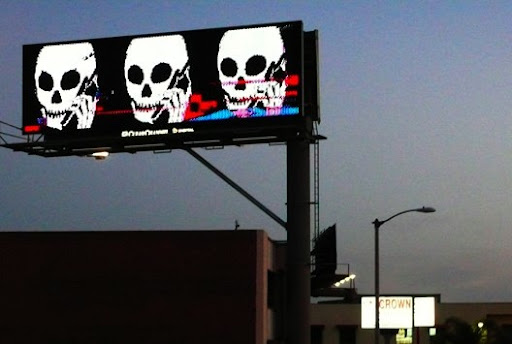
Clear Channel electronic billboards get hacked UPDATE: no they didn't, maybe


According to Engadget, via textually.org, an 18 year old grafitti artist known as Skullphone has hacked about 10 digital billboards in Southern California to insert his artwork into the screens' ad loops.

Clear Channel's definitely going to need to learn about security -- quick -- if they plan on (a) making a serious attempt in this market and (b) not getting fined (or worse) the first time somebody decides to be a bit less innocuous and delete the firm's entire playlist in favor of some select clips from a favored porn site.

[UPDATE]: According to new "news" (I have to put it in quotes when the source is a semi-anonymous tip to a gadget blog), there was no hacking and in fact "Skullphone" paid Clear Channel for the placements as a one-day promotion of... something. That, and there are unicorns living on the moon, Elvis was seen driving on I-40 with Jimmy Hoffa, and Chuck Norris's tears do in fact cure cancer. Ok, I can't confirm that last part, however I do know that if I were Clear Channel and my massively expensive digital screens were hacked, I might well be inclined to lie about it. I'm not saying that they did -- it's admittedly more likely that somebody paid them to do this -- but if they were hacked... well... I'll just leave it at that.

Tags: , ,

Tuesday, March 25, 2008

Wendy's putting digital ads in bars

Wendy's and agency MediaVest New York have decided to promote the QSR's goods via a digital out-of-home campaign on 5,100 Ecast digital juke box screens in bars and restaurants. In a sudden outbreak of common sense, they apparently realized that they could target only those locations located within one mile of a Wendy's, in an attempt to encourage late-night revelers to take a short walk and get a cheap meal or snack, according to AdAge.

The Ecast units will feature content that straddles the line between kiosk and digital signage. While browsing for music to play, users may run into an unobtrusive banner-style ad, which, when touched, can expand into a full-blown interactive micro-site.

While the concept is pretty exciting, Wendy's spokesperson Bob Bertini said this type of campaign is "very
new" for the company and noted that despite this being the second campaign they've run with Ecast (the first was in January
for a special "99-cent Stack Attack" promotion), that it's still too early
to quantify return on investment. Of course, with a $435M digital ad budget to spend and a mandate from the higher-ups to do anything and everything to win over the coveted 18-34 year old demo, I'd be surprised if they didn't try any more of these hyperlocal campaigns out this year.

Tags: , ,

Friday, March 21, 2008

Media buyers: does digital signage get unified or bundled?

AdAge has an interesting interview online with Chris Geraci, who was recently installed as the new National TV buying director at Omnicom Group's OMD (they work for PepsiCo, Apple and other glitzy advertisers). Here's the most interesting back-and-forth of the interview:
MediaWorks: Thanks to viewing online and watching shows on mobile devices, buying TV ad time has changed. How prepared is your group to start putting together multimedia ad packages that include TV ad time and other marketing ideas?

Mr. Geraci: We've been doing that for years, and I think we're pretty darn good at it. ... We haven't forced our digital expertise, if you will, into the upfront marketplace or digital buyers or digital clients into a TV scenario. Certainly there are places where the combined leverage makes sense. We do a lot of business with certain media owners both online and offline, and those are the places where we will begin the negotiation together. MTV Networks is an example where we've had a fair amount of press.
So if I'm reading that right, it sounds to me like the ability to package together different media is more important/useful/valuable than being able to sell them on the same scale. This is one of those things that we talk about quite a bit in the digital signage community -- on the one side are those who feel that unless and until digital signage space can be sold in a similar (or identical) fashion to television, we're not going to get any buy-in from media planners. On the other side are people who feel that it's a different medium from TV, and needs to be sold as such.

I'm with the latter group, in case you're wondering, but given that I have nothing to do with advertising and media buying/planning, I tend to just sit here in the ivory tower and watch as the other guys slug it out :)

Tags: ,

Thursday, March 20, 2008

And the winners are...

POPAI Digital announced the big winners of the second annual Digital Signage Awards contest last night in a star-studded gala event. We had a great pool of entries this year, many of which were significantly better than some of the best spots from last year. In addition to the gold, silver and bronze medalists listed below, this year we also awarded two special prizes, for Digital Signage Network of the Year, and Digital Signage Content of the year. The lucky winners were: PRN and Wal-Mart for the Content award for their spot for introducing Oreo's new Cakesters product, and MTi and Verizon Wireless for the Network award, for their interactive display wall network. Here's the complete list of winners, including those for POPAI's OMA awards (for static POP). Warning: it's a PDF link.

Congratulations to all the winners, and thanks to everyone who participated this year. I'm going to see about posting some of the winning videos and images so you can judge for yourself whether or not it's the best in the industry. Don't agree with our choices? Then show us what you're made of, and make sure to enter in next year's contest!


Government/Education/Corporation
  • Content
    • Silver - USPS/Post Office of the Future by Draft FCB for the U.S. Postal Service
  • Network
    • Gold - Bloomberg by Scala Broadcast Multimedia for Bloomberg
    • Silver - Reuters InfoPoint by Wireless Ronin Technologies for Reuters
    • Bronze - Digital Signage Network for SAIT Polytechnic by Omnivex Corporation
Health Care
  • Network
    • Bronze - Fraser Health Network by Omnivex for Fraser Health
Hospitality/Entertainment
  • Content
    • Silver - Mike's Hard Lemonade Spot by Artisan Complete for Mark Anthony Brands
  • Network
    • Silver -Yum! Brands/KFC Digital Menu Boards by Wireless Ronin Technologies for Yum! Brands
    • Bronze - Krystal by Scala Broadcast Multimedia for The Krystal Company
Retail
  • Content
    • Gold - Oreo Cakesters spot by PRN for Kraft Foods, Inc.
    • Silver - Radeberger Gruppe KG / Jever Familia Markt by SEEN MEDIA GMBH & CO KG for Radeberger Gruppe KG
    • Bronze - Holiday Photo Card spot by PRN for Wal-Mart
    • Bronze - PNC Bank - No ATM Fees spot by John Ryan for PNC Bank
  • Network
    • Gold - Verizon Wireless "Interactive PDA Wall" by MTI, Inc. for Verizon Wireless
    • Silver - PNC Bank - Digital Signage Rollout by John Ryan for PNC Bank
    • Bronze - Harley-Davidson In-Store Branded Media Program by Nanonation for Harley-Davidson
Transportation/Transit
  • Network
    • Silver - Lamar digital billboard network by Scala Broadcast Multimedia for Lamar Digital